
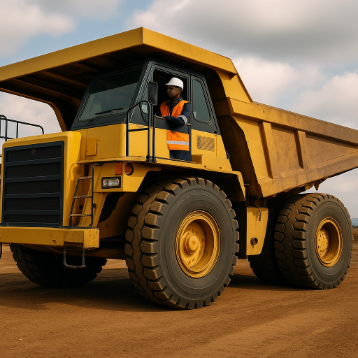
Operating a 777 rigid dump truck is not simply a matter of moving material from one point to another. It demands judgment, spatial awareness, technical understanding, and a disciplined approach to safety. In mining, quarrying, and large-scale earthmoving environments, these machines work under pressure and in conditions where mistakes can be costly. That is why proper training has real value: it develops operators who can handle the vehicle with confidence, protect people on site, and contribute to smoother, more reliable production. For anyone considering 777 DUMP TRUCK TRAINING IN LOUISTRICHARDT, understanding the broader benefits of this training is the first step toward making a smart career decision.
Why 777 rigid dump truck training matters
A 777 rigid dump truck is a powerful piece of heavy equipment designed for demanding industrial work. Its size, load capacity, and operating environment make it very different from smaller commercial vehicles or general plant machinery. Training is therefore essential not only for legal and workplace compliance, but also for practical competence.
Good training helps learners understand how the machine behaves when loaded, how terrain affects stability, how braking distance changes under different conditions, and why communication with spotters, supervisors, and other operators is critical. It also introduces the routines that shape safe operation every day, such as pre-start inspections, hazard identification, correct loading and dumping procedures, and shutdown protocols.
Without formal instruction, an operator may pick up only fragments of the job. With structured training, the learner develops a complete operational picture. That difference matters because heavy equipment work depends on consistency. The best operators do not rely on guesswork. They rely on training, procedure, and awareness.
The core benefits of 777 DUMP TRUCK TRAINING IN LOUISTRICHARDT
One of the strongest advantages of 777 DUMP TRUCK TRAINING IN LOUISTRICHARDT is that it gives learners access to practical, role-specific preparation rather than broad, generic machinery exposure. The focus stays on what operators actually need in the field: machine familiarity, site discipline, and confident handling in real work settings.
For those looking into 777 DUMP TRUCK TRAINING IN LOUISTRICHARDT, the most valuable programmes are usually the ones that combine technical instruction with supervised practical learning. That balance is important because heavy equipment competence is built through both knowledge and repetition.
The main benefits typically include:
- Improved safety awareness: Learners understand risk zones, blind spots, haul road discipline, reversing procedures, and safe dumping practices.
- Better machine control: Training builds confidence in steering, braking, gear selection, maneuvering on gradients, and operating with a load.
- Maintenance awareness: Operators learn to identify warning signs, perform basic inspections, and report faults before they become serious mechanical issues.
- Workplace readiness: Formal instruction helps learners adapt to site rules, reporting lines, communication standards, and daily operating routines.
- Stronger employability: Employers generally value candidates who arrive with focused training and a clear understanding of heavy equipment responsibility.
These benefits do not sit in isolation. Together, they shape an operator who is safer, more dependable, and more useful on an active site.
What quality training should cover
Not all training experiences are equal. The strongest programmes go beyond basic machine familiarisation and prepare learners for real operational demands. They teach not just how to move the truck, but how to work responsibly within a larger production system.
A well-structured course should usually cover the following areas:
| Training area | What it includes | Why it matters |
|---|---|---|
| Machine fundamentals | Controls, gauges, systems, start-up and shutdown procedures | Builds a clear operational foundation |
| Safety procedures | Risk assessment, PPE, site rules, emergency response, communication | Reduces preventable incidents and unsafe habits |
| Pre-operation checks | Tyres, fluid leaks, brakes, lights, steering, structural checks | Supports safe use and early fault detection |
| Operating techniques | Loading approach, haul road driving, turning, braking, dumping, parking | Improves control, efficiency, and stability |
| Site awareness | Traffic patterns, loading zones, dumping edges, weather and ground conditions | Helps operators make better decisions in changing environments |
| Basic maintenance reporting | Defect identification, logbooks, operator responsibilities | Protects the machine and supports uptime |
The value of this structure is simple: it prepares operators for the realities of the job, not just the appearance of competence. A learner may know the controls quickly, but professional operation requires deeper understanding of sequence, judgment, and discipline.
How training supports safety, productivity, and machine care
The benefits of 777 rigid dump truck training reach beyond the individual operator. A properly trained operator supports the wider site. Safety improves when procedures are followed consistently, productivity improves when loads are moved smoothly and on schedule, and machine care improves when early warning signs are not ignored.
Consider how these outcomes connect in day-to-day operations. An operator who performs thorough pre-start checks may identify a problem before the truck enters the production cycle. An operator who understands haul road etiquette is less likely to create dangerous conflict with other vehicles. An operator trained in controlled dumping techniques helps reduce unnecessary stress on the machine and lowers the chance of incidents in tipping areas.
These are not small advantages. In heavy industrial environments, the quality of equipment operation affects pace, cost control, maintenance planning, and site culture. Skilled operators help create calm, orderly routines. Poorly trained operators often create avoidable disruption.
Key habits strong training encourages
- Checking before moving: inspecting the machine and surrounding area before every shift or relocation.
- Driving to conditions: adjusting speed and handling to slope, surface, visibility, and load.
- Communicating clearly: using the correct signals and reporting hazards or defects promptly.
- Respecting procedure: following designated routes, loading instructions, and dumping protocols.
- Thinking ahead: anticipating risks rather than reacting too late.
These habits are often what separate a basic operator from a trusted one.
Career value and what learners should look for
For many people, the appeal of this training is practical: it can open the door to work in mining, quarrying, construction support, and material handling environments where heavy vehicle skills are in demand. But training should not be viewed only as a route into a job. It should also be seen as the beginning of a professional standard.
Employers generally look for more than the ability to sit in the cab and move a truck. They want reliability, awareness, and evidence that the candidate understands the seriousness of operating high-value machinery in a high-risk environment. That is why formal instruction can carry long-term value. It gives learners a stronger base from which to grow into more advanced responsibilities over time.
When evaluating a training option, learners should look for a few essentials:
- A clear balance between theory and practical work
- Instruction that covers safety in a detailed, site-relevant way
- Guidance on pre-start checks and defect reporting
- Assessment standards that test real competence, not just attendance
- A training environment that promotes professionalism and discipline
Choosing carefully matters. The right learning experience does more than prepare someone to pass a test. It prepares them to step onto a site and operate with confidence, awareness, and accountability.
In the end, the benefits of 777 DUMP TRUCK TRAINING IN LOUISTRICHARDT are clear. It equips learners with technical skill, strengthens safety awareness, supports better machine care, and improves readiness for demanding work environments. Most importantly, it builds the habits and judgment that heavy equipment operation requires every single day. For anyone serious about working with rigid dump trucks, proper training is not an optional extra. It is the foundation of safe performance, professional credibility, and long-term career growth.
——————-
Check out more on 777 DUMP TRUCK TRAINING IN LOUISTRICHARDT contact us anytime:
NDAA TRAINING ACADEMY 0828421211 – Heavy Equipment and Safety Training
http://679a82a174cae.site123.me/
082 842 1211
Thohoyandou, South Africa
NDAA TRAINING ACADEMY 0828421211 – Heavy Equipment and Safety Training
TLB
GRADER
FORKLIFT
FIRST AID
EXCAVATOR
REACH TRUCK
MOBILE CRANE
REACH STACKER
LHD SCOOPTRUM
FRONT END LOADER
ADT AND 777 DUMP TRUCK
TELESCOPIC BOOM HANDLER
OCCUPATIONAL HEALTH AND SAFETY


